
Poetry
Poetry & Art
Two of Wales’ most distinguished poets, Gillian Clarke and Professor Tony Curtis, each came to possess examples of Colin Jones’ evocative barge pictures — works originating from sketches he made along the River Severn at Lydney (Gloucestershire) during his later years. Nearly four decades later, both poets independently responded to these artworks through poetry. Gillian Clarke’s poem, ‘A Barge on the Severn’, was inspired by her oil painting of the same name. The poem appears in her 2009 collection ‘A Recipe for Water’, which features a detail of the painting on its cover. Professor Tony Curtis’ ‘Abandoned Barge’ is based on Jones’ 1966 work ‘Abandoned Barge at Lydney on the Severn’, the artist’s largest known drawing. The poem is published in Curtis’ 2008 collection ‘Crossing Over.’
Both poems and images of the corresponding artworks, are presented below.
Abandoned Barge
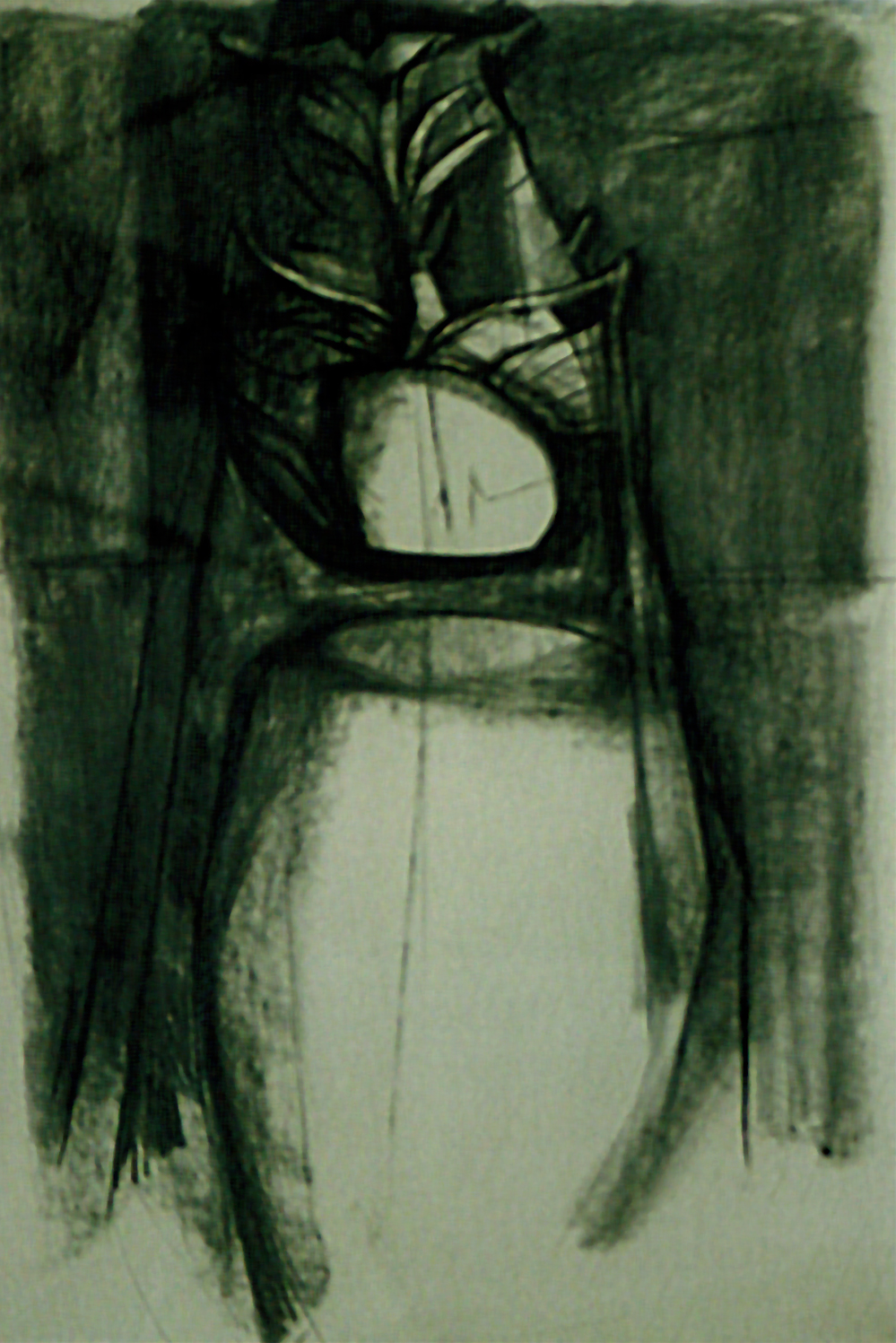
Rising from the silt a beached axle-tree.
What is in the world, may also be a sign:
we see what we want there to be.
This mud-banked boat
at Lydney on the Severn
had a working life, turn and turn about,
coming to this point of rest.
Was worked by the weather
and the big tides’ press:
the moon-pulled sea rising full
for the Vernal and Autumnal sluicing
of this river, turning everything over.
So you stopped that day
to look, and sketched this split hull –
the shaded mud, the lines of force,
hollowed spaces around the world’s wide pole,
the warped keel and winged spars
risen like a spectre,
the carpenter’s challenge,
the bare abstraction of the cross
you’d come to witness.
– Tony Curtis –
A Barge on the Severn
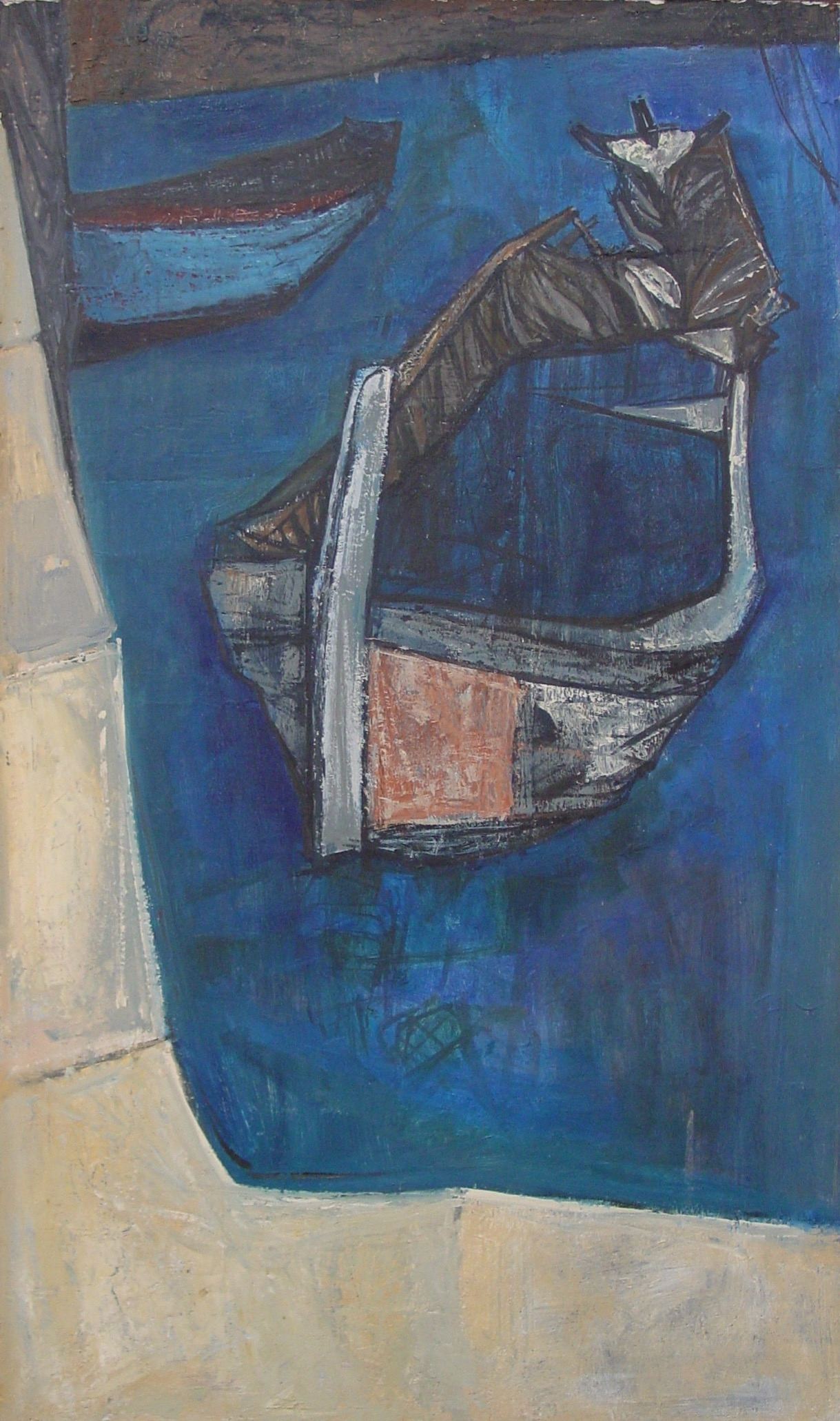
Where river becomes estuary,
before losing its name to the sea
in water angled by a harbour wall,
on the tilt of the tide’s rise and fall,
between mudflats, saltmarsh and flood plain,
a boat with the sea in its lap, or rain.
He could have put the river to bed,
baled out the barge, drowned to its gunwale
in flood, in the hope of letting it float.
But he caught the hour and held it,
the cruciform spars of the stern where light
and a salt wind off the channel
still make its lost sail snap in a cross wind,
and the colours brought home in his mind
– red flaking and faded to rose,
and the blue-green of water – have held
forty years, while he, the barge, a particular
hour, timbers, molecules, pigment, particles,
are swept with the soils and silts of Pumlimon
to become the Severn.