Biography
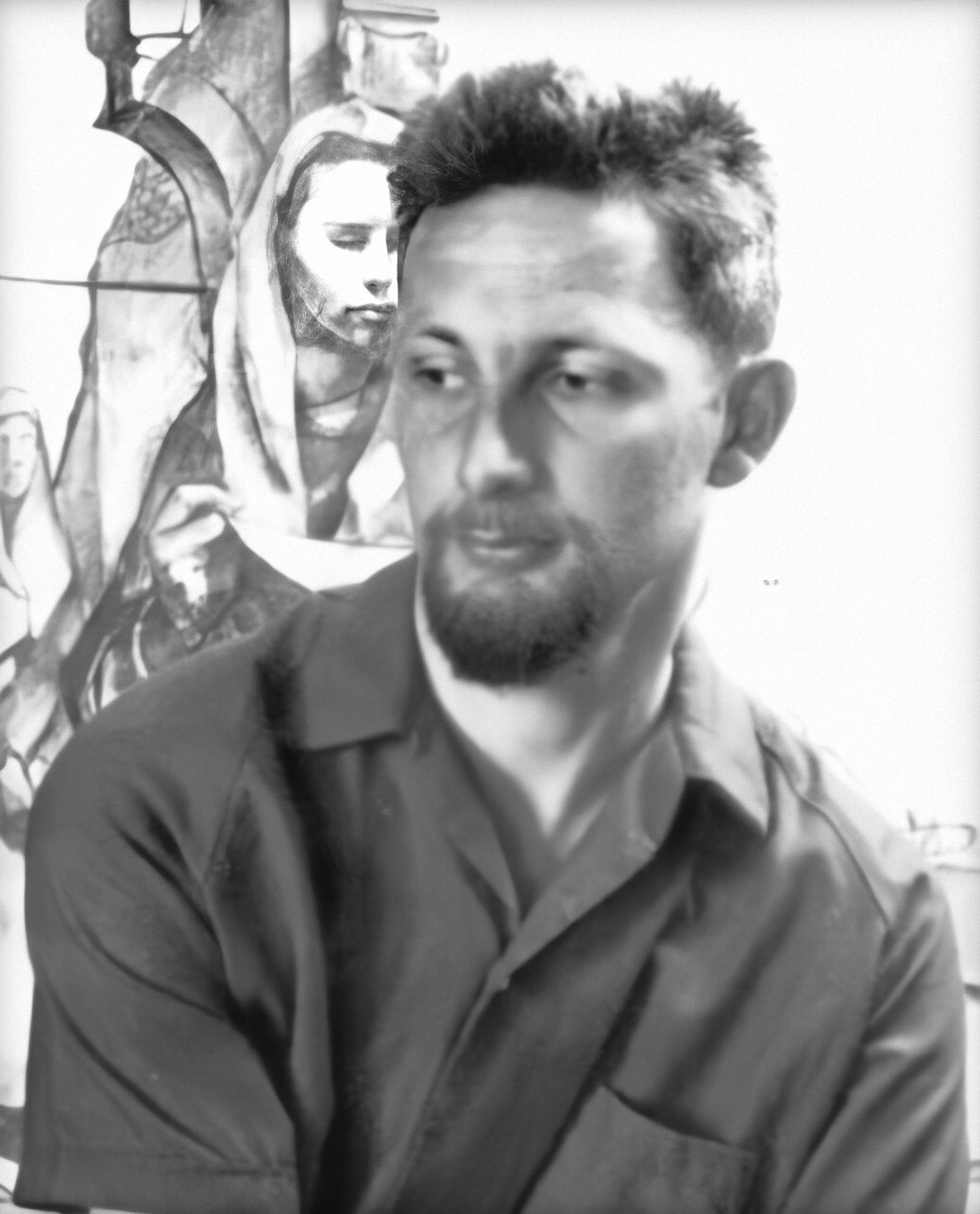
Colin Herbert Beyne Jones (1928–1967)
He was born in Newport, Gwent, the only child of intellectually engaged and self-educated parents who were committed to ensuring that their son had access to the broadest possible range of opportunities. As a delicate child, Jones spent his school holidays working on a farm in the Wye Valley, a practice intended to build him up physically. His father Stanley Jones, a former regimental boxing champion, also taught him the fundamentals of boxing.
At the age of sixteen, Jones left school and enrolled at Newport School of Art (1), where he came under the tutelage of the painter Thomas Rathmell, a formative influence on his early artistic development. During his studies, he interrupted his training to undertake eighteen months of National Service (2). During the six-month interval between his military discharge and the resumption of his formal education, Jones completed a City & Guilds certificate in painting and decorating, seeking to acquire a deeper technical understanding of oil painting— his principal medium.
School of Art, Family & Teaching
He subsequently pursued an Art Teachers’ Diploma at Cardiff School of Art (3), where he met his future wife, the fine art weaver Jean Hodge. Among his contemporaries at Cardiff were Ernest Zobole, Charles Burton, and other artists who would later be associated with the Rhondda Group.
Jones began his teaching career at Gowerton Boys’ Grammar School (4), an institution previously attended by the painter Ceri Richards. During his tenure, he produced a number of portraits of local individuals, including a particularly notable work depicting Ruth, a retired cockle gatherer from Penclawdd. Executed in a sombre palette with dynamic, expressive brushwork, this portrait exemplifies the style that characterized his pre-professional portraiture.
His subsequent appointment was at Quakers Yard Grammar School (5), during which he became actively involved in the Merthyr Tydfil art community. Among his notable works from this period is a portrait of the poacher Bill Power, painted in a stylistic continuity with his earlier Penclawdd period. In addition to portraiture, he produced a substantial body of landscape paintings, frequently depicting chapels, terraced housing, and pigeon lofts—motifs resonant with the vernacular architecture and social fabric of South Wales.
Travelling and Early Commissions
In the late 1950s, Jones commenced extra-mural lecturing for the University of Wales, which included several lecture tours in France. He was subsequently appointed Schools’ Services Officer (6) at the National Museum of Wales — a position that afforded him the opportunity to travel extensively throughout the country. During this period, he often lived and worked out of a Volkswagen campervan, which served both as transportation and mobile studio.
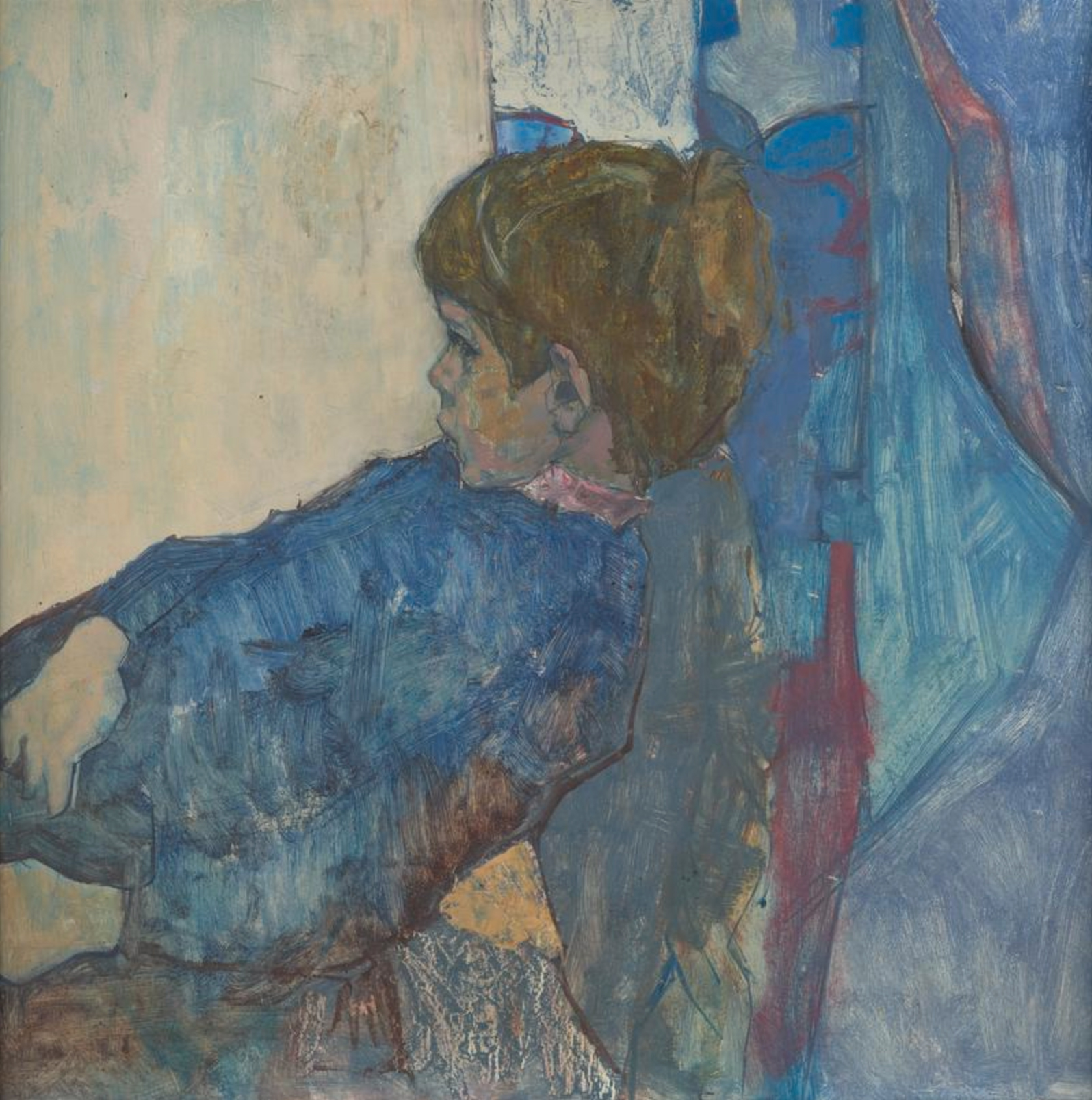
By the end of this period, Jones had established himself as a highly proficient portraitist. Although he possessed the skill to sustain a livelihood through commissioned work, he found the associated expectations artistically restrictive and eventually chose to forgo portrait commissions. Nevertheless, he continued to produce a number of distinguished portraits of friends and family, marked by the same sensitivity and technical assurance that characterized his broader oeuvre.
Colliers & Miners
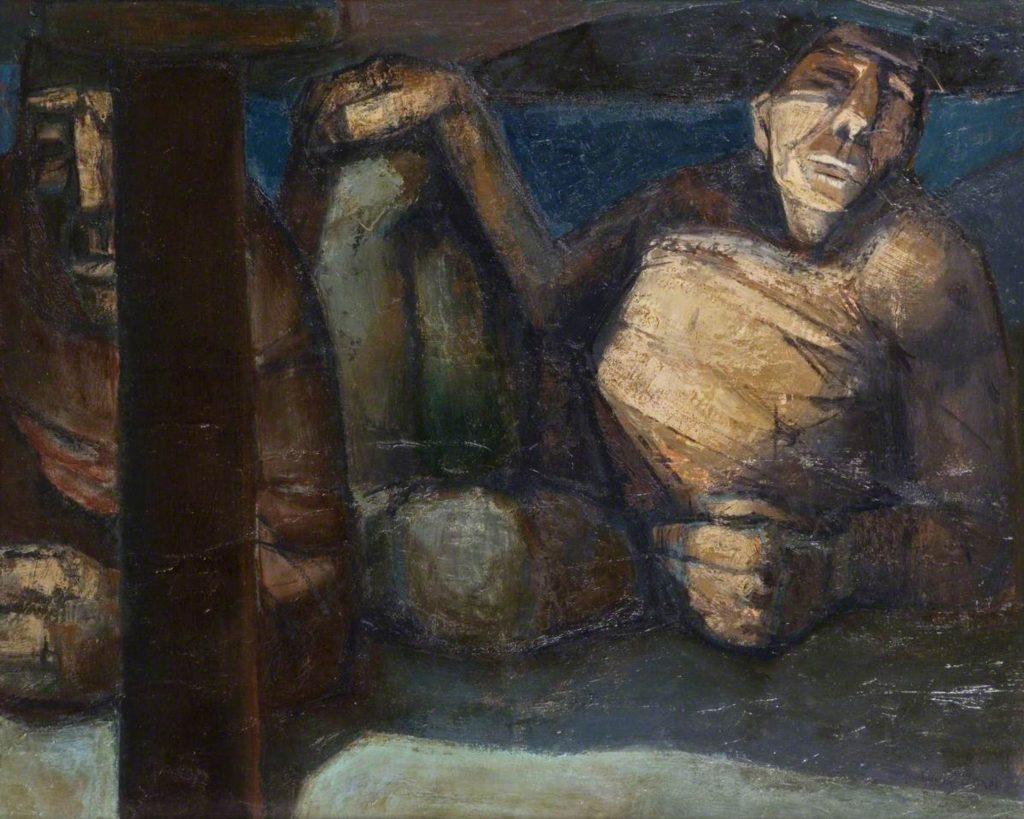
In 1962, Jones was granted access to the Lady Diana drift mine, where he spent a week underground producing a series of powerful ink drawings depicting miners at work and at rest. From these sketches, he developed four oil paintings, two of which — ‘Colliers’ and ‘Miners Resting’ — are now held in the collection of the National Museum Wales, which also owns several other works by the artist. The third surviving painting from this series was acquired by the wife of Lord Heseltine as a wedding gift for her husband, and remains part of the Heseltine collection, which includes three additional works by Jones.
Following this period, Jones was appointed Her Majesty’s Inspector of Art for Wales (7), succeeding Evan Charlton, himself a distinguished painter and former Head of Cardiff School of Art.
Pen & Ink France
Jones’s artistic development was notably influenced by the painter Josef Herman, whose depictions of working-class life resonated with Jones’s own thematic preoccupations. Deeply connected to his Welsh heritage, Jones frequently portrayed the industrial landscapes and valley communities of South Wales. One of the most emotionally charged works of his career emerged in response to the Aberfan disaster; his painting ‘Pithead Funeral’ stands as a testament to his sensitivity to national tragedy and social suffering.
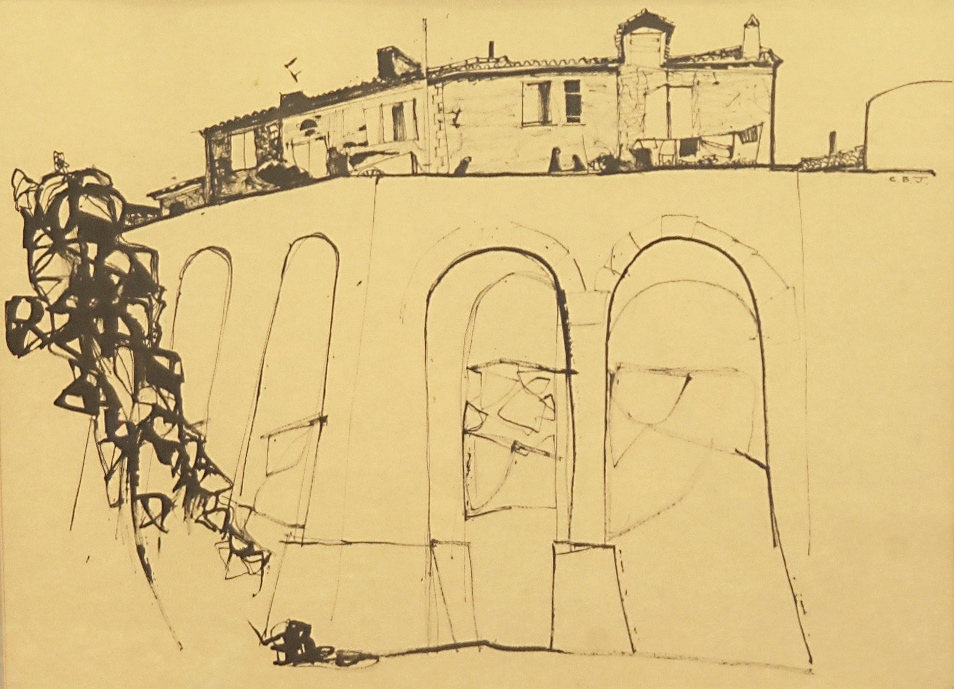
Jones spent his annual holidays in the Languedoc region of southern France, where he engaged in daily drawing using hand-cut reed pens. His subjects during these sojourns were typically medieval farms and villages, many of which were later developed into oil paintings.
Shortly before his death, he changed the spelling of his middle name from “Beyne”—a reference to his Argentine godfather—to “Beynon,” an act reflecting his enduring pride in his Welsh identity. Jones died in his late thirties, leaving behind a substantial body of work comprising drawings and paintings of considerable artistic and cultural value.
(1) 1944 – 1946
(2) 1946 – 1948
(3) 1948 – 1951
(4) 1951 – 1957
(5) 1957 – 1961
(6) 1961 – 1963
(7) 1963 – 1967