
Contemporary Reviews
“Paintings With a Wealth of Meaning” by Harry Lea
The drawings and paintings of Colin Jones are sufficient evidence of the contribution he made to the contemporary art of Wales. His superb draughtsmanship and remarkable grasp of colour are stated with an economy of touch and certainty of vision.
The bold design and sombre colour scheme in the portrait of Father Caesar emphasizes the delicate flesh tones and colours of the head. Here the minute detail of the time worn features are expressed within the basic structure of the main plains. Beyond these technical achievements the artist has caught the kindly, sympathetic understanding, reflected in the eyes of his subject and the forward leaning angle of the total design. The simplicity of figure and gown is, nevertheless, full of modulated colour and graphic emphasis which reveals substance and volume.
The general characteristics of Colin Jones’ work owes much to his training under Thomas Rathmell at the Newport School of Art, but without question the facility of his talent was encouraged by his personal grasp of essentials in form and colour together with a fine rectitude of character and a deep respect for truth. In his recent paintings there is a clear paring down of unessentials and his vision centres on clear and undisturbed shapes within which he conveys a wealth of meaning by the skill of calligraphic brushwork or broad slabs of accenting colour. There is a primitive strength here which recalls early Gothic painting or stained glass. The “Pithead Funeral” with rich golden colour and a dramatic use of bold linear forms or “Fallen Figure” illustrate these qualities.
The “Red Chapel” No 8 or “Mother and Child” owe much to his grasp of design. Their severity is, however, much softened by the sensitive linear brushwork used with cunning assurance and economy having much in common with Chinese scroll paintings. This Oriental feeling is even more marked in the drawings, as may be expected. In fact the tiled roofs of Montricoux have a distinct pagoda like appearance. The “Church and Cypress Trees”, “Dead Vines” and “Growing Maize” all contribute perhaps by their clear and powerful line in breadth and wealth of expression to an Oriental sense of draughtsmanship which extends into the many studies of “Prie Dieu, Bruniquel”.
It is, however, in the paintings and drawings of children that his personal achievement reaches supreme heights. Colin Jones’ work will grow in esteem and value because of its sincerity and truth. His untimely death, as well as being a great tragedy, is a loss to the art of Wales which is emphatically demonstrated by this memorial exhibition.
“Cwmbran Exhibition” by Bryn Richards
The tragic accident which, last year, cut short the life of Colin Jones, robbed Wales of a man whose influence on the development of Welsh art, both as administrator and painter, was powerful and expanding. His outlook was not narrowly regional; more than many painters he was aware of art as an international language and his knowledge and love of the cultures of other times and places were a constant source of inspiration. There is, none the less, a strong Welsh flavour about his work, particularly evident in the paintings, which shows his kinship with a number of men whose work is well known in Wales, notably Will Roberts, Josef Herman, Thomas Rathmell.
This exhibition at Llantarnam Grange, Cwmbran, is sponsored by the South Wales Group. The drawings show that acute and sensitive observation of fact was the basis of Jones’s art; their directness and spontaneity is the result of a rigorous elimination of unnecessary detail, and a concentration on formal and structural essentials. This is clearly seen in the drawings of trees, buildings and plants made in France in August of last year. Jones’s concern for formal clarity can be seen in all his work, not only for its own sake but more in the interest of the precise expression of the human significance of the subject.
The paintings fall into two groups: those in which drawing and painting fuse in the service of an analysis of form and character, such as the portrait of “Paul”; and those which are heavier in technique and more Expressionist in feeling such as “Pit-Head Funeral” and “Seated Figure.” I saw little indication that Colin Jones was moving towards any synthesis of these coexistent styles except, perhaps, in the very dignified and moving portrait of Father Caesar which must have been among the last works he painted.
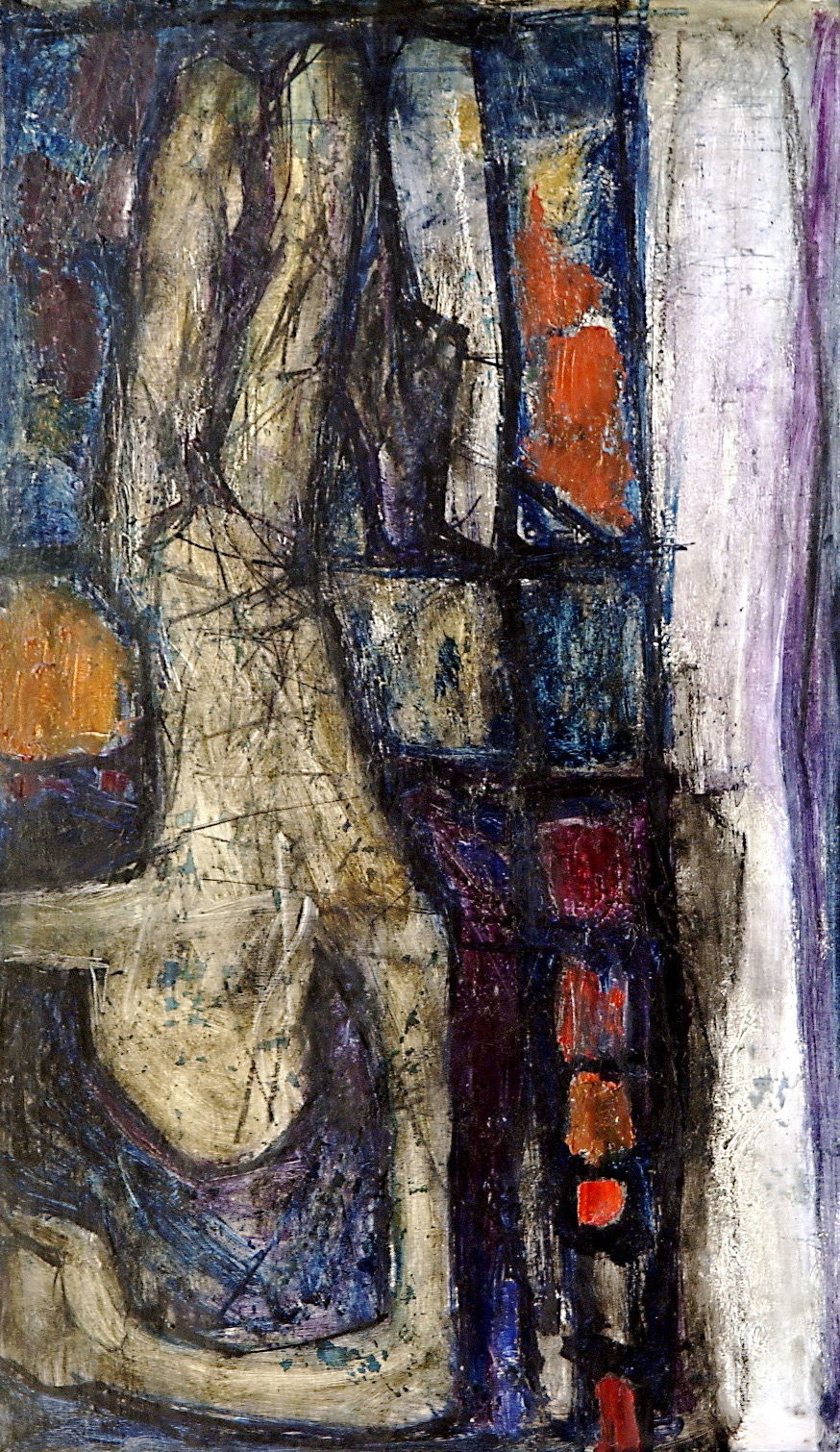
Fallen Figure
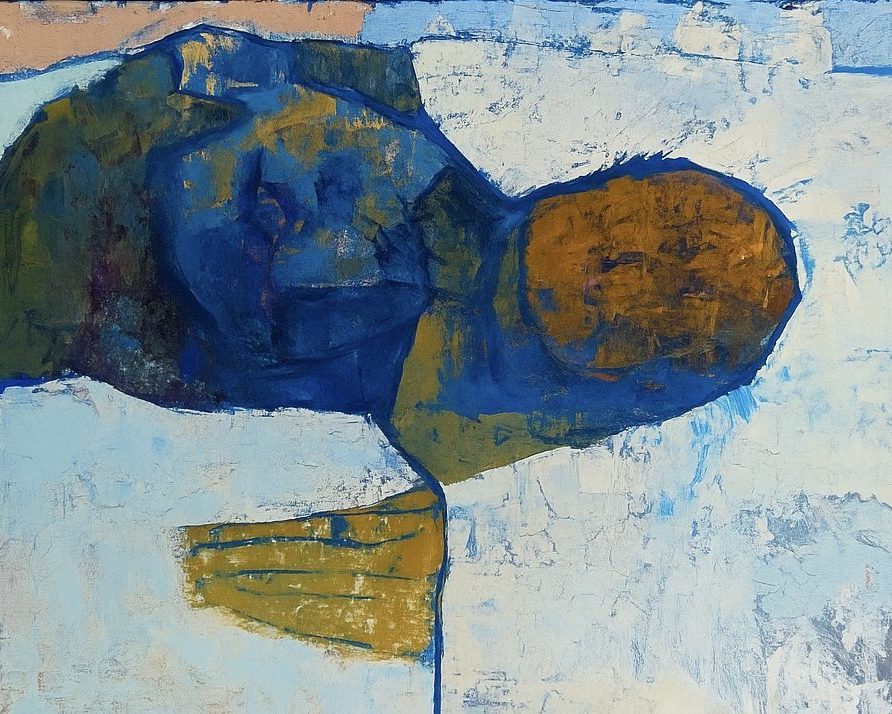
Mother and Child
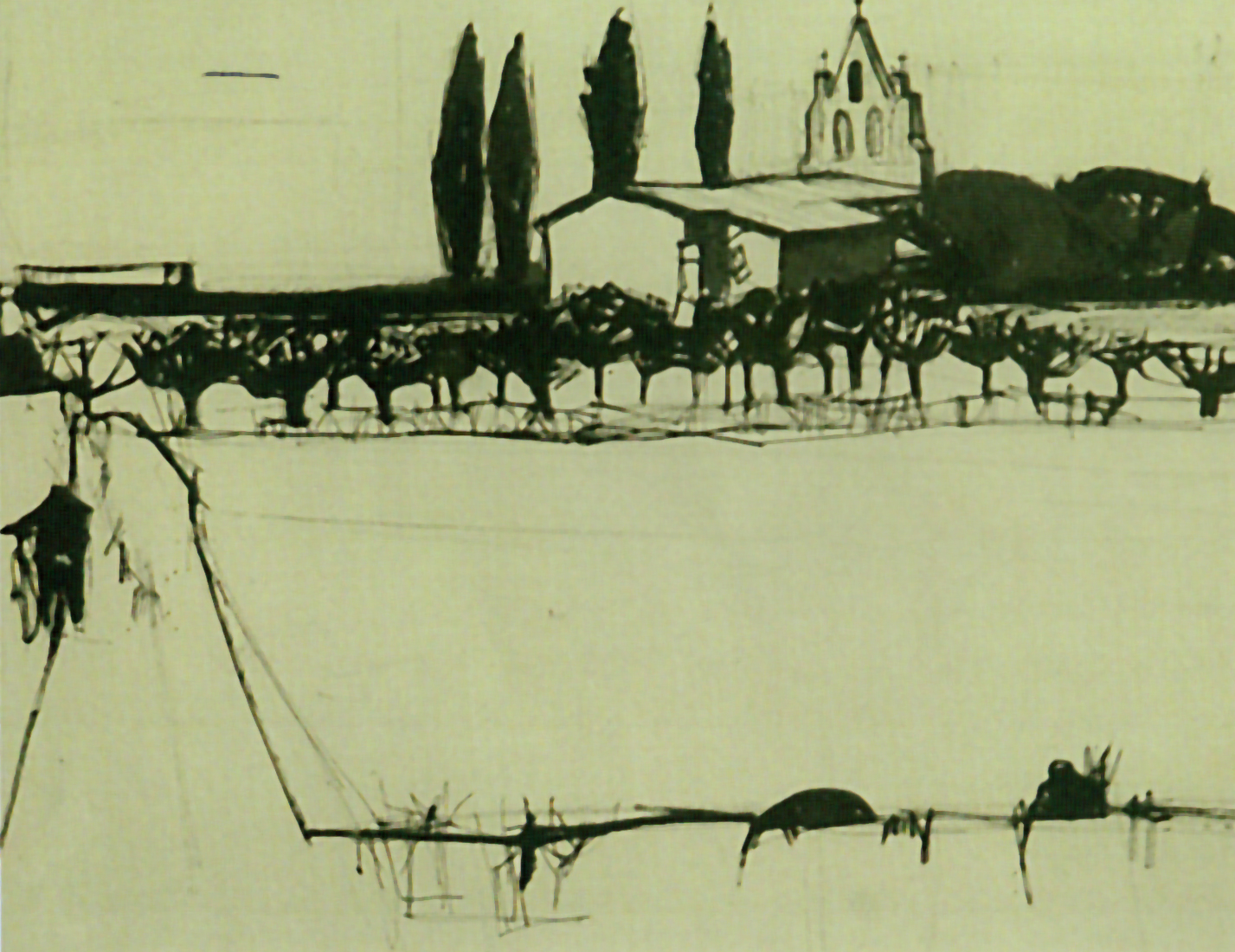
Church and Cypress Trees
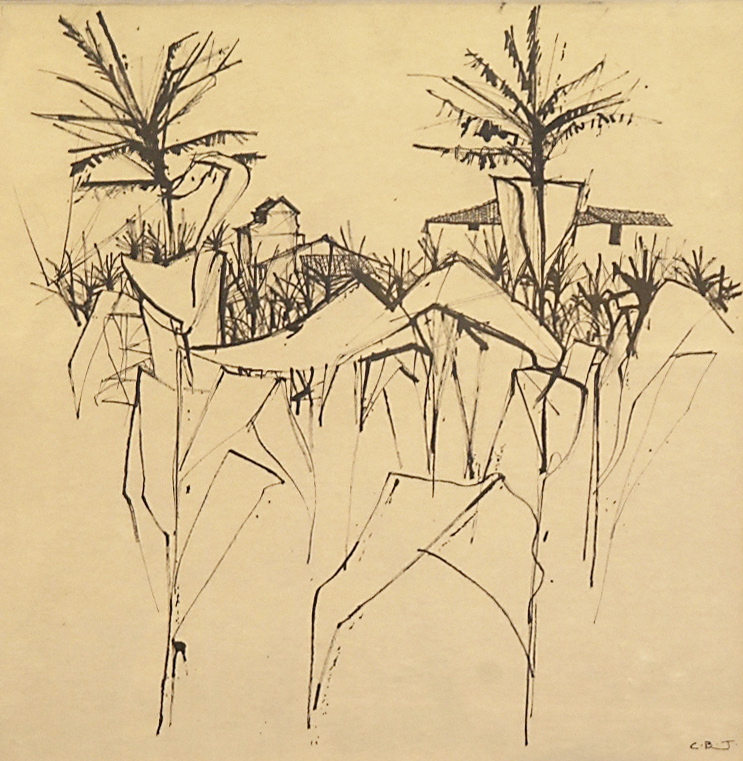
Growing Maize